
There’s a well recognized dynamic in business of the pendulum of bundling and unbundling services and products.
Innovators unbundle specific capabilities of products and focus on doing it better and in a new way. Later, companies then bring these focused products together in a process of bundling, creating better bundles than the previous ones because of the improved capabilities of the parts.
This 2022 post from StartupMarketer is a good primer of how the cycle plays out.
In tech specifically there have been a couple of well talked about examples over the years of startups being successful on a strategy of unbundling a specific capability. In 2019 Ross Simmonds (@TheCoolestCool) posted about the numerous opportunities from unbundling Excel.

Going back further, this 2010 post by Andrew Parker (@andrewparker) talks about the same for unbundling Craigslist.

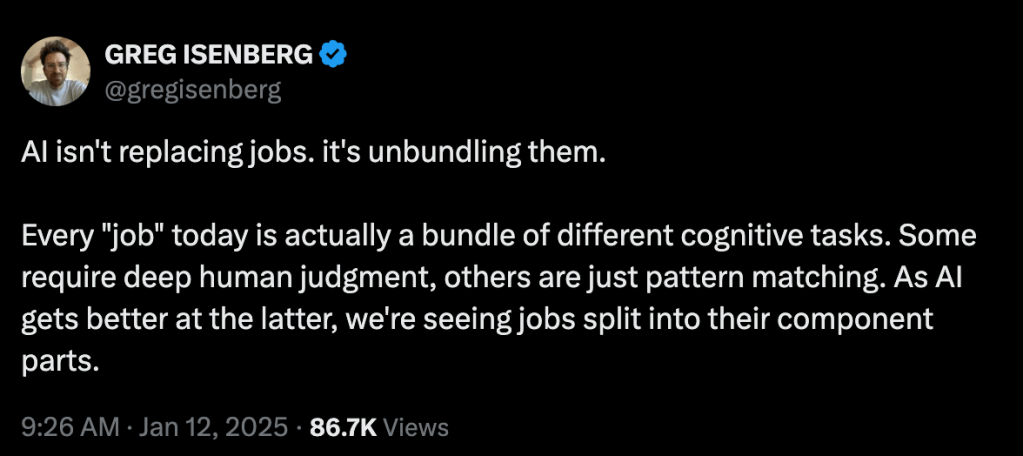
A few days ago a recent post on X from Greg Isenberg (@gregisenberg) resonated with me, and also brought into focus the opportunity for entrepreneurs to exploit this unbundling in a manner that parallels the classic product/service unbundling/bundling cycle.
Let’s unpack that starting with what even is a job? It’s the responsibility to fulfill the expectations of a role, which is the set of skills (literally: “skill set”) that people with a particular background and aptitude have in order to achieve specific types of goals for the business.
You have a job, filling a role, to apply your skills, to achieve goals.
One way to think about applying AI into a business setting is to start at the left with the Jobs that people have. It’s a captivating prospect to think about, of the “huge if true” variety, and a good bet directionally in the limit. AI will definitely take on more and more capability in a “software is eating the world” type of way.
But, in an approach made famous by Amazon, let’s “work backwards”.
That is: Goals <- Skills <- Roles <- Jobs. The goals are the outcomes we want to work backwards from. Organizations achieve goals with skills applied by people in roles who are employed with jobs.
Hidden in there are the unstated people-centered assumptions. Certain types of people have certain types of skills. These skills naturally bundle into roles based on the aptitudes people tend to naturally have (and we deem them a “unicorn” if they go beyond that). Roles require people in jobs to fill them. People require jobs with a typical work-week worth of demand on their time (more accurately, people can’t split their efforts in too many directions without losing effectiveness).
Here in early 2025, with the age of Agents all the rage, the consensus view (and for some, fear) seems to be that we’re imminently going to see the plugging of “AI Agent” into the “Job” socket. Instead of having a person with a job to fill the role, put an AI Agent into a role instead.
As sexy as the “virtual person” approach sounds, what’s already happening that the X post identifies (and where I think there is a ton of value creation) is in the unbundling of skills from roles. In many cases the roles (for people) will continue to exist, but with a focus on different skills, and leverage for greater impact.
As an example, center stage of the wholesale AI replacement theory is the Software Engineer, which is also the role I’m most familiar with – with years of experience at all levels of individual contributor, architect, CTO, and hiring for and managing these roles as an engineering leader. If one looks realistically at the role of Software Engineer it encompasses a lot of skills of planning and problem solving at multiple levels of abstraction. Someday those all may be bundled into a single Agent but it won’t be soon.
What has already happened though is the unbundling of some of the skills the role has required. Things like coding certain types (or parts) of a solution, reviewing pull requests with feedback, becoming familiar with a code base, etc. Keep an eye on Devin for progress on that front.
But there’s a large number of skills for the Software Engineering role that aren’t so readily solved yet, and probably not soon. Providing technically informed feedback on requirements. Evaluating and expressing tradeoffs with requirements and implementation options. Doing design and building a document, weighing feedback from others on that design. Reviewing design documents and giving useful feedback. Weighing and making architecture and technology choices. Weighing implementation decisions (languages, frameworks, databases) for flexibility given ideas about the possible future directions of the project. Most critically, designing novel solutions to novel problems, creating new architectures, frameworks, languages, etc.
I’m not saying those are impossible in the long run to capture with AI. But I do think that there is a long enough transition time to adjust and until then an AI Agent can’t get to the level of Senior Software Engineer (nevermind Staff or Principal).
Betting against AI is a suckers game at this point, but things can be directionally true and still allow for massively valued counter-thesis opportunities along the way.
So while the dynamics aren’t all the same as the unbundling of products/services in a market, there are I think good lessons for entrepreneurs to apply to the unbundling of jobs. Lots of opportunity for unbundling skills from roles to give the people in those roles more leverage (ie, higher productivity). It’s a win-win for entrepreneurs because ultimately this creates the condition for the eventual bundling of related skills.
What about Klarna?
I think Klarna is the company that has gotten the most attention, cutting their workforce by 1200 people (from 5000 or so) mainly by replacing their customer support with ChatGPT-based capability.
The losses for the people involved are very real, but given the state of the technology it makes sense this would be the first area to be nearly automated away. The skill of this role was about access to a particular kind of information and the ability to communicate it interactively.
Even older versions of NLP technology were able to largely take on the functionality of this use case on many sites (with products such as Drift, Intercom, etc.). So much so that it was already becoming ubiquitous to have a little overlay in the lower corner of site windows asking “How can I help you?”
So I don’t think this particularly portends that all jobs are on the chopping block for replacement in the short term, the unbundle was fairly straightforward. Critically, the skills of the role did not have room for creativity.
Take-aways
Entrepreneurs will find and exploit the opportunities for role unbundling of skills in roles they are familiar with. For now this will largely change the nature of roles versus replace them.
People in knowledge-work roles, you should be aware of the skills that make up your role, or the roles you would like in the future, and evaluate which are ripe for unbundling to AI. The highest value human skills are related to judgment in novel situations, creative problem solving across abstraction levels, and where high EQ is required. Working with AI that unbundles other skills previously in your role or can make you better at these will lever up your impact.
Software Engineers specifically – take a breath and recognize that the job is changing (it always has been) and the shift in focus in skills will continue. Solutions for unbundled skills will continue to develop but I think the true bundling to an AI Agent Software Engineer is far enough down the road that you can stay ahead of the curve if you are mindful.
Businesses should keep their goals in focus and of course adopt AI skill unbundling that will increase the leverage of their workforce. But they should go beyond doing the same with less, and do more with more. If you don’t do more, somebody else will.
Other takes on job unbundling? What are you seeing? Hit me up on X.
 Richard Shea's Blog